
How to Search Kent County Traffic Court Records
The main online tool for a Kent County traffic ticket lookup is Michigan Court ePay, the statewide pay-and-search portal for civil infraction tickets. The 63rd District Court directs ticketholders to ePay for any civil infraction filed in that court. The portal accepts a search by name and ticket number, by name and date of birth, or by driver's license number. The court warns that a new citation can take 3 to 5 business days to reach the system after the officer writes it, so a same-day lookup may return no result.
For a full docket-level view, use MiCOURT Case Search. MiCOURT covers participating courts statewide and shows the case number, the parties, the charge, the hearing dates, and the disposition. It is not a document vault. Sealed files, set-aside cases, and old paper tickets need a clerk visit at the court that holds the file.
The image below shows the 63rd District Court traffic page, the local landing point that explains how to use ePay, mail in a plea, or request a hearing.
Source: 63rd District Court traffic page.
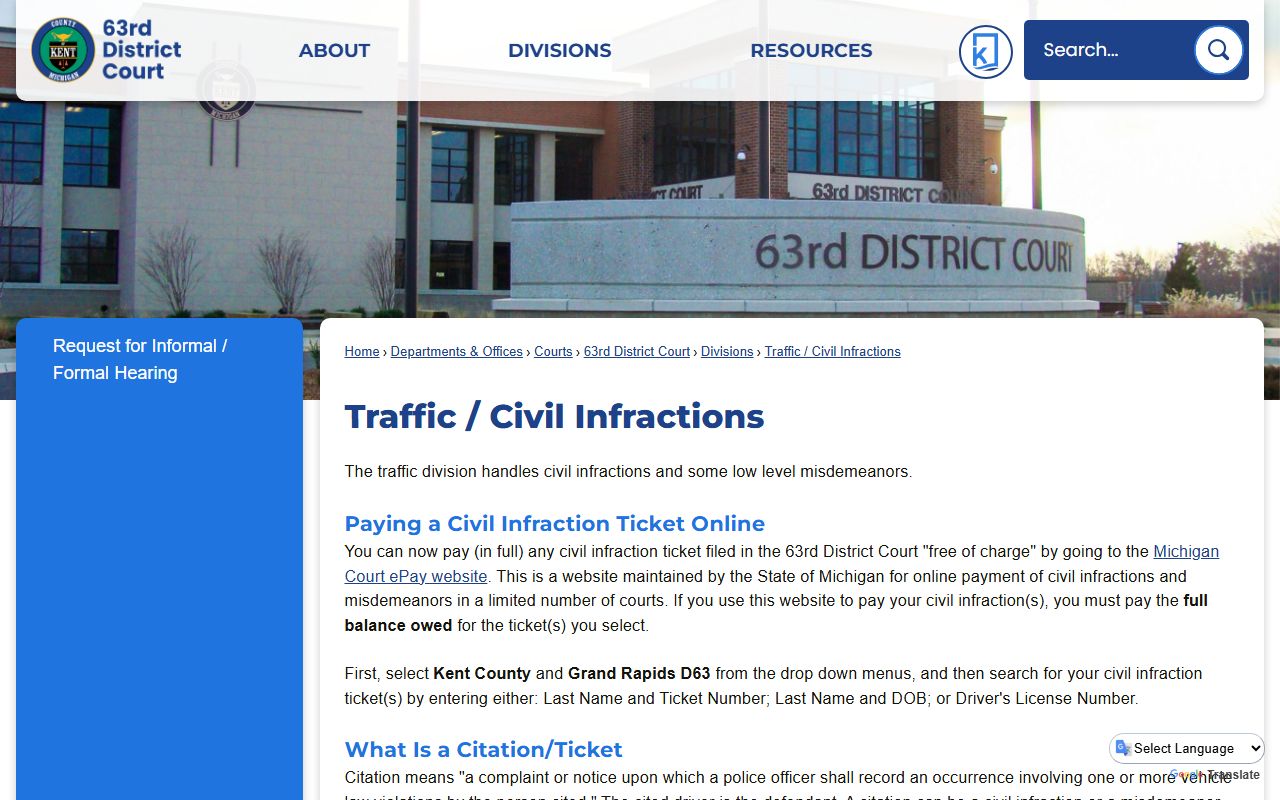
Have the ticket in hand before you search. The citation lists the issuing court, the ticket number, the date, the officer agency, the cited statute, and the response deadline. The court named on the ticket is the only court that can take a plea or set a hearing. The 63rd District Court page is explicit about this point: if the ticket is from another court, that court must be contacted directly.
Which Courts Handle Traffic Cases in Kent County
Kent County is split among six district courts. Each district court runs its own traffic docket. A citation written by Grand Rapids police lands in the 61st District Court. A citation from the Kentwood Police Department lands in the 62-B District Court. A citation written by the county sheriff in an out-county township will most often land in the 63rd District Court at 1950 East Beltline Avenue NE.
- 61st District Court: City of Grand Rapids tickets.
- 59-1 District Court: City of Grandville tickets.
- 59-2 District Court: City of Walker tickets.
- 62-A District Court: City of Wyoming tickets.
- 62-B District Court: City of Kentwood tickets.
- 63rd District Court: all other areas of Kent County not covered by the city courts.
A few criminal traffic charges, like felony OWI or fleeing a police officer in the third or fourth degree, may start in district court and move to the 17th Circuit Court after a probable-cause conference and a preliminary examination. The district court still holds the early file. The circuit court takes the case after bindover.
Types of Traffic Cases on Record
Not every ticket is the same. Michigan splits driving offenses into civil infractions and misdemeanors. The path through the court, the cost, and the record itself all shift based on that split. A civil infraction is not a crime. A misdemeanor traffic offense is a crime and may carry jail time, points on the license, and a public criminal record.
- Civil infraction: speeding, careless lane use, no proof of insurance shown at the stop, expired plate, and most stop sign or signal violations. Paid by fine and costs. No jail. May carry points.
- Misdemeanor traffic: driving while license suspended, OWI first or second, reckless driving, leaving the scene with damage. Carries possible jail, fines, and a criminal record.
- Felony traffic: OWI third, OWI causing death or serious injury, fleeing and eluding in higher degrees, and certain repeat offender cases.
- Local ordinance: city ordinance traffic offenses that follow the city code and are filed in the city's district court.
- Parking: city parking tickets handled by a city parking bureau, not the district court, unless contested up to court.
- Equipment and registration: defective lights, no insurance proof, missing plate, and broken signals.
The 63rd District Court traffic page notes that the court handles civil infractions and some low-level misdemeanors at the traffic division window. Higher-level criminal traffic cases move through the criminal division at the same court.
What Kent County Traffic Court Records Show
A Kent County traffic record carries the basic file data on the ticket and the docket entries that follow. The table below lists the fields a public user can expect to see on a docket page or a clerk printout. Some fields, like a driver's full date of birth or a license number, may be redacted on a public view but still appear on a certified copy.
| Field | What It Shows |
|---|---|
| Citation / Ticket Number | The unique number printed on the ticket. Used as the cleanest lookup key. |
| Court | The district court that holds the case (63rd, 61st, 59-1, 59-2, 62-A, or 62-B). |
| Case Number | The court's own case ID assigned at filing. Differs from the ticket number. |
| Defendant | Full name of the cited driver. Address may be redacted on public views. |
| Issuing Agency | The police or sheriff agency that wrote the ticket. |
| Statute or Ordinance | The cited section, such as MCL 257.627 for basic speed. |
| Offense Date | The date the stop or violation was made. |
| Plea or Response | Admit, admit with explanation, or deny. |
| Court Date | The date of the informal or formal hearing, if any. |
| Fine and Costs | The dollar amount due. May include a state assessment. |
| Disposition | Responsible, not responsible, dismissed, or amended. |
| License Action | Notes on points reported, license sanction, or no action. |
| Warrant Status | Bench warrant or default flag if the driver failed to appear. |
The court traffic record does not include the driver's full point history. That sits on the state driver record kept by the Michigan Secretary of State. A complete picture takes both files.
Searching by Citation Number vs by Name
Michigan Court ePay supports more than one lookup style. The 63rd District Court traffic page sets out the exact steps. Pick the right combo based on what is in front of you. A ticket number gives the most exact hit. A name plus a date of birth is the next best path. A driver's license number works well for a driver who has lost the ticket.
| Field | Type | Required | Notes / Format |
|---|---|---|---|
| County | Dropdown | Yes | Select Kent County. |
| Court | Dropdown | Yes | Select Grand Rapids D63 for the 63rd District Court. Pick the matching city court for city tickets. |
| Search Mode | Radio | Yes | Last Name + Ticket Number, Last Name + DOB, or Driver's License Number. |
| Last Name | Text | Conditional | Used in two of the three search modes. |
| Ticket Number | Text | Conditional | The number printed on the citation form. |
| Date of Birth | Date | Conditional | MM/DD/YYYY format. |
| Driver's License Number | Text | Conditional | The full Michigan or out-of-state license number. |
| Search | Button | Yes | Runs the query against the ePay system. |
If the lookup returns no result, give the system a few days. The court has stated that a new citation can take 3 to 5 business days to reach the court system from the field. A name search may also miss if the cited name on the ticket does not match the driver's legal name on the license. Try a partial last name with the date of birth if a full match fails.
Paying or Contesting a Kent County Traffic Ticket
The 63rd District Court gives drivers three plea options on a civil infraction. The same broad path applies at the city courts, but the local phone, fax, and counter rules can shift. Phone admissions are not accepted by the court. The court allows 20 days from the date the citation was received to avoid late charges, even if the ticket itself reads 5 to 15 days. The steps below set out the basic flow at the 63rd District Court.
- Read the citation. Note the issuing court, the ticket number, the response deadline, and the listed statute or ordinance.
- Decide the plea. Admit responsibility, admit with a written explanation, or deny responsibility.
- To admit and pay, use Michigan Court ePay with no added court charge, or mail a check or money order payable to 63rd District Court after calling the court at 616-632-7770 for the exact amount.
- To admit with explanation, send a letter to the magistrate by mail or hand it in at the counter. The court will mail back a judgment of sentence with the final fine and costs.
- To deny, submit a hearing request form by mail, by fax to 616-363-6211, or in person. Ask for an informal hearing with the magistrate and the officer, or a formal hearing in front of the judge.
- Show up on the hearing date. If the driver fails to appear, the court may enter a default responsibility, impose sanctions, and report the failure to the Michigan Secretary of State, which can suspend the license.
- Pay any balance. Credit card payments in person are limited to Visa, MasterCard, and Discover, with signature and a photo ID. Personal checks are not accepted if a bench warrant has issued or the payer has paid with an NSF check before.
For a city ticket, contact the city court named on the ticket. The 61st District Court for Grand Rapids and the city district courts each set their own counter hours and payment options. Do not assume a city ticket can be paid through the 63rd District Court system.
Public Access Laws for Traffic Court Records
Traffic case files in Kent County are court records under Michigan Court Rule 8.119. MCR 8.119 sets the access rules for court files, the case index, the documents, and the limits. Civil infraction files and most misdemeanor traffic files are public. Juvenile traffic cases are restricted under MCL 712A.28. The Michigan FOIA at MCL 15.231 covers county and police administrative files, not court case files. The two paths use different forms and different fees.
Some traffic case data may be redacted on a public view to protect minor names, social security numbers, financial account data, or protected addresses. A clerk cannot waive a fee without a court order, and a clerk cannot give legal advice on a pending case. For form help and walk-in support, the Kent County Legal Assistance Center sits on the 5th floor of the courthouse at 180 Ottawa Avenue NW.
Note: Use MCR 8.119 for a Kent County traffic case file at the court. Use Michigan FOIA for a police agency report, dashcam policy, or an internal sheriff policy.
Court Traffic Records vs State Driver Records
Two separate files exist for almost every Michigan driver with a ticket. The court traffic record is held by the district court that took the case. The state driver record is held by the Michigan Secretary of State. The two files are linked by the conviction-reporting process, but they live in different systems and follow different rules. The table below sets out the basic contrast.
| Feature | Court Traffic Record | State Driver Record |
|---|---|---|
| Source | District court that took the citation (63rd, 61st, 59-1, 59-2, 62-A, or 62-B). | Michigan Secretary of State (SOS), Lansing. |
| What's in it | Citation number, court case ID, charge, plea, fine, hearing dates, disposition. | License status, points, suspensions, revocations, reinstatement, master driving history. |
| Where to access | MiCOURT Case Search, Michigan Court ePay, or the clerk counter at the court. | Michigan Secretary of State driving record order page or a branch visit. |
| How to correct errors | File a motion in the court that holds the case file, or ask the clerk about a clerical correction. | Contact the SOS Driver Assessment Center or request a hearing through the SOS. |
| Typical use | Hearing prep, plea history, payment proof, set-aside motion. | Employer check, CDL check, insurance review, court bond review. |
An insurance company or an employer asking for a driving record almost always wants the state driver record, not the court file. The court file is the right pull for a defense attorney, a hearing prep, or a motion to set aside an old conviction.
CDL and Commercial Driver Records
A driver with a commercial license follows stricter rules. A CDL holder cannot use a deferred plea to keep a moving violation off the driver record, even if the violation occurred in a personal car. Some traffic offenses are serious or major under federal motor carrier rules and carry CDL disqualification on top of the state license action. The court that takes the citation still handles the plea and the fine. The CDL action sits on the state driver record at the Michigan Secretary of State.
For Kent County CDL drivers, the safest path is to call the court named on the ticket, get the exact fine and any plea options, then ask the Michigan Secretary of State or a defense attorney how that disposition will hit the CDL record. The court clerk staff cannot give legal advice on CDL effect, but they can confirm what the file shows.
DUI / OWI Cases
Michigan uses the term OWI, operating while intoxicated, for what other states call DUI or DWI. OWI is a misdemeanor on a first or second offense and a felony on a third. The case starts at the district court that covers the stop location. OWI cases follow the criminal docket, not the civil infraction docket, so the ePay civil infraction portal does not apply. For more on OWI handling, court process, and arrest records, see the Kent County arrest records page.
An OWI case generates more than one file. The district court holds the criminal case. The Michigan Secretary of State enters an administrative license action. The Kent County Sheriff records the booking on the jail inmate system if the driver was held. Each office has its own record path.
Deferred Adjudication and Defensive Driving Course
Michigan offers a Basic Driver Improvement Course (BDIC) for some civil infraction tickets. A driver who is eligible and completes the BDIC inside the deadline can avoid points being reported to the Michigan Secretary of State on that ticket. The eligibility rules sit on the Michigan Secretary of State site, not the court. The 63rd District Court does not promote BDIC on its traffic page, but the court will accept a BDIC certificate of completion when the rules apply.
Michigan does not have a general deferred-adjudication program for traffic offenses the way some other states do. The state does have a separate statute, MCL 769.4a, for some drug cases, and the 7411 statute for certain first-time drug pleas, but neither is a traffic statute. A driver in Kent County looking for a deferred path on a misdemeanor traffic charge should consult a defense attorney before the first court date.
Sealing or Set-Aside of Traffic Records
Michigan does not use the word "expungement" in the statute. The legal term is set aside. The main statute is MCL 780.621. Most traffic misdemeanors and some traffic felonies can be set aside if the driver meets the wait period and the offense is on the list. A few traffic offenses, like DUI, were not eligible for set-aside for many years; the 2021 Clean Slate Act expanded the list to cover a first-time OWI in some cases. The rules are technical. A driver should read the current statute or talk to a Kent County defense attorney before filing.
A set-aside drops the case out of public criminal-history searches once a judge signs the order, but the file stays visible to courts, police, and some licensing bodies. The 63rd District Court page lists Expungement as a public resource on the criminal division side. A motion to set aside is filed in the court that took the original conviction, not in the circuit court.
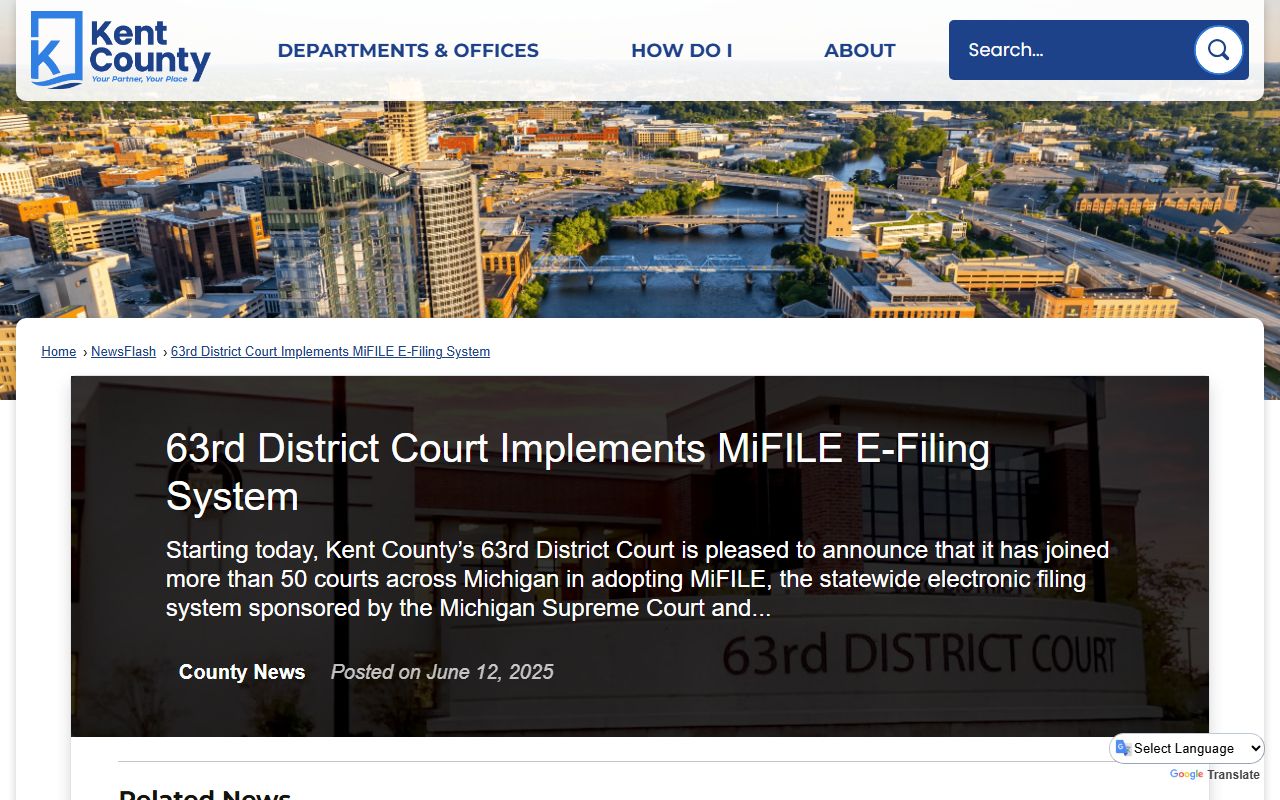
The image below shows the 63rd District Court news page on MiFILE, the e-filing tool now used for civil filings at the court and for some criminal motions in time. A set-aside motion in many courts is now filed through MiFILE.
Source: 63rd District Court MiFILE implementation news, June 12, 2025.
A civil infraction is not a criminal conviction. It cannot be "set aside" the same way. A driver who wants to challenge a civil infraction after the deadline must file a motion to set aside the default in the same court. The court can grant or deny based on good cause.
Fees for Traffic Record Copies
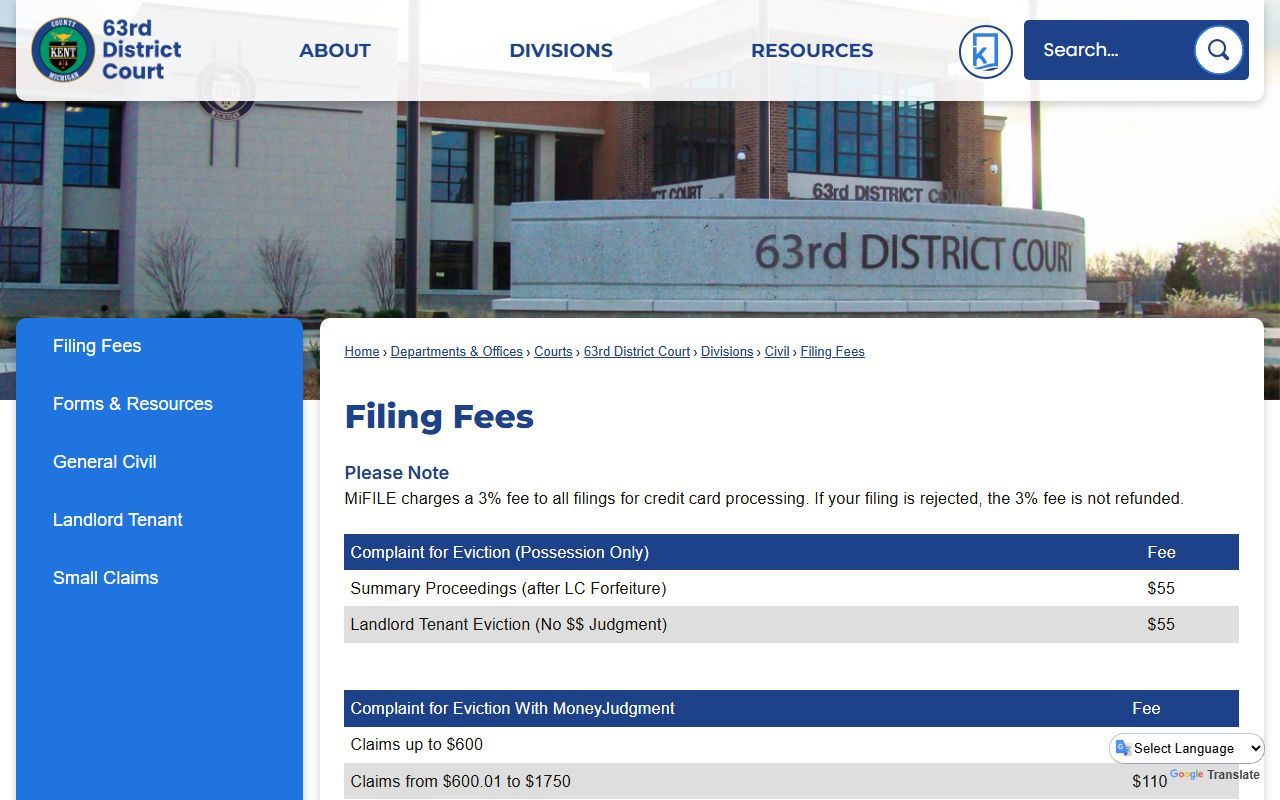
Most fines on a Kent County civil infraction follow the Michigan State Court Administrative Office fine schedule, with local court costs added on top. The 63rd District Court does not publish a single flat fine for every offense, because the dollar figure shifts by speed band, by school zone, by repeat status, and by the cited statute. The court does publish a fee schedule for civil filings and processing. The table below sets out the published 63rd District Court filing fees that touch the traffic and civil side.
| Item | Fee |
|---|---|
| MiFILE credit card processing | 3% on filings; not refunded if filing is rejected |
| Civil infraction ticket (paid through Michigan Court ePay) | No added court charge above the ticket fine |
| In-person credit card payment (Visa, MasterCard, Discover) | Signature and photo ID required |
| Complaint for Eviction, possession only | $55 |
| Small Claims, claim up to $600 | $30 |
| Small Claims, $600.01 to $1,750 | $50 |
| General Civil, claim up to $600 | $35 |
| General Civil, $10,000.01 to $25,000 | $160 |
The image below shows the 63rd District Court filing-fee page, the source for the dollar figures above. The court can revise the schedule, so the published page is the controlling source on the day of filing.
Source: 63rd District Court filing-fee schedule.
Copy fees for a certified traffic case file are set by court rule and the local clerk. Call the traffic division at 616-632-7770 for the exact dollar amount before mailing in a request. For court-record requests outside the traffic division, see the Kent County court records page or the Clerk of the Court page.