
How to Search Kent County Probate Records
The first stop for a Kent County probate records search is MiCOURT Case Search at micourt.courts.michigan.gov. MiCOURT lets the public look up cases by court, party name, or case number. Pick Kent County Probate Court from the court list if it appears in the system. The portal shows docket entries, parties, filing dates, fiduciary names, and status. It does not give the full text of a will, an inventory, or an account. For those files, the user needs to go to the Probate Court counter or send a written request.
The image below shows the Kent County Probate Court main page, which is the official starting point for most probate questions in Grand Rapids.
Source: Kent County Probate Court.
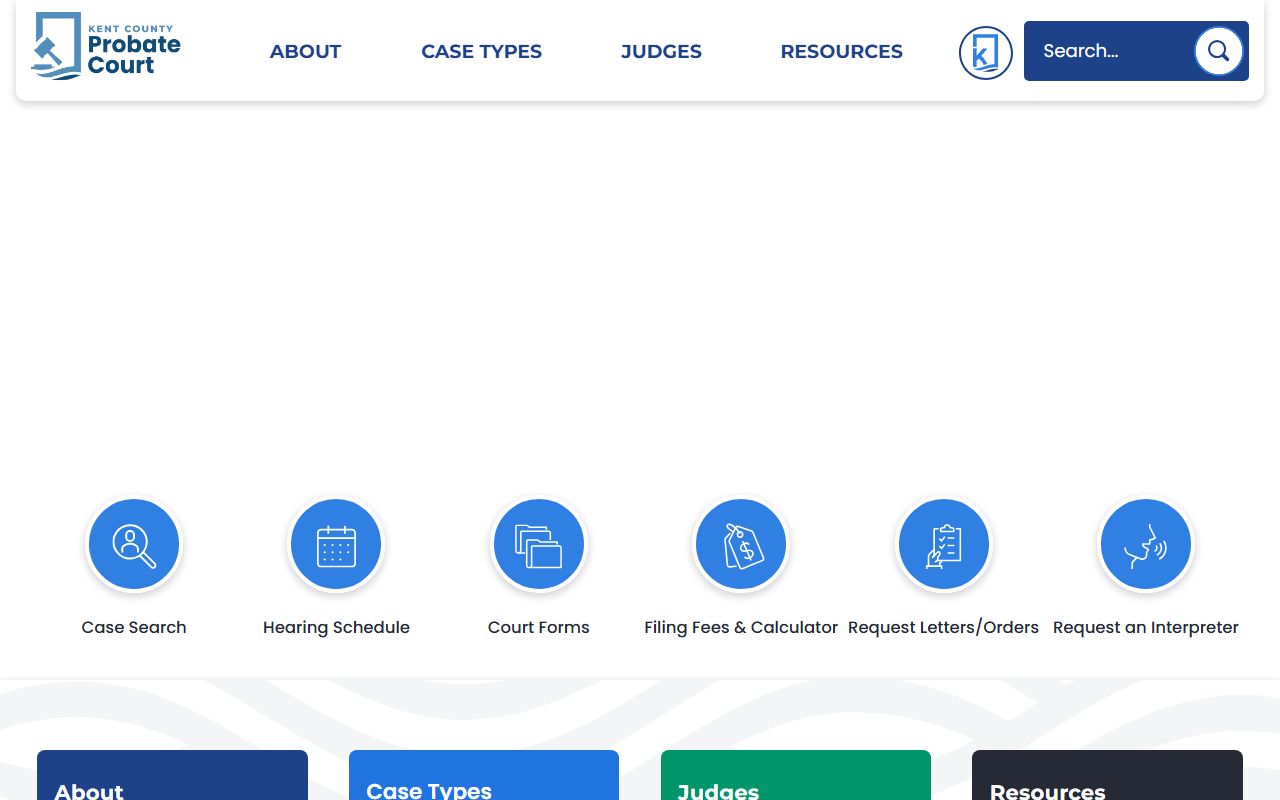
The court page lists hours, the front-counter address, and links to fee and form pages. Many probate forms in Michigan come from the State Court Administrative Office, also called SCAO. The same forms are used in every county, but each court holds its own files. So a will filed in Grand Rapids stays at the Kent County counter and is not stored in another county.
Probate case types fall into a handful of buckets. Decedent estates open after a death. Guardianships protect a minor or an adult who cannot make safe choices. Conservatorships manage money for a protected person. Trust matters and will deposits also flow through the Probate Court. Each type has its own forms and its own fee.
Kent County Probate Court Office
The Probate Court front counter is on the 25th-floor suite of the Kent County Courthouse in downtown Grand Rapids. Court staff process filings, accept inventory and account paperwork, and issue letters of authority for fiduciaries. The counter is open to the public for filings most weekdays. The phone line covers a longer window of the workday for general questions.
Kent County Probate Court
180 Ottawa Avenue NW, Suite 2500
Grand Rapids, MI 49503
616-632-5440
Fax: 616-632-5430
Office hours: Mon-Fri 8 am - 5 pm
Front counter for filings: 9 am - 4 pm
Photo ID and security screening are part of any visit to the courthouse. Probate staff can confirm what a file shows and explain how to file a form, but they cannot give legal advice on a case. For form help, the Legal Assistance Center sits one floor up on the 5th floor of the courthouse and is open to self-represented users.
What Kent County Probate Court Covers
Probate Court is the trial court that handles death, capacity, and protective matters. In Michigan, the same court holds wills, estate files, and guardianships. It also takes mental-health petitions. That is a wider job than many people expect from a probate office, and it is why probate records can look so different from one file to the next.
Common Kent County probate case types:
- Decedent estate: formal or informal probate of a will, or an intestate estate when no valid will exists.
- Small estate: a faster process for estates under a set dollar limit.
- Will deposit: a living person deposits a will with the court for safekeeping.
- Trust: court oversight of a trust, often when a dispute arises.
- Guardianship: court appoints a guardian for a minor or an adult.
- Conservatorship: court appoints a conservator over a protected person's money or property.
- Minor settlement: court approval of a money award to a minor.
- Mental-health petition: civil commitment and related orders, with strict access rules.
Each case type has its own forms, its own service rules, and its own fee path. A small estate may close in weeks. A formal estate with a contested will can run for a year or more. A guardianship can stay open for years and require yearly reports to the court.
Probate Filing Steps in Kent County
Most probate filings in Kent County follow a similar arc. The exact form set varies by case type, but the steps below cover a standard decedent-estate or guardianship file. SCAO forms are the base; the court counter checks each one before docketing.
- Identify the case type. Decedent estate, small estate, will deposit, trust, guardianship, conservatorship, minor settlement, or mental-health petition.
- Pull the right SCAO forms. The State Court Administrative Office publishes Michigan probate forms used in every county.
- Search MiCOURT first if you are not sure whether a file already exists for the decedent or protected person.
- File the petition and any required forms at the Probate Court front counter, by mail, or by e-filing where allowed.
- Pay the filing fee. Ask about a fee waiver if you cannot afford the cost.
- Serve notice on heirs, interested persons, the protected person, or agencies as required by court rule.
- Attend the hearing if one is set. Some informal estates do not need a hearing.
- Receive letters of authority, letters of guardianship, or letters of conservatorship if the court appoints you.
- File the inventory, the annual account, proofs of service, reports, and the closing documents as the court requires.
Missing a deadline or skipping a notice can stall a file. Many self-represented users get help from the Legal Assistance Center for the forms and then return to file at the counter.
Probate Filing Fees in Kent County
The Probate Court posts its fee schedule online. The headline fee for a decedent estate is the same for a formal probate and an informal probate. Other items, like inventory fees, are set by state law and grow with the value of the estate. The image below shows the official fee schedule page used by the Kent County Probate Court.
Source: Kent County Probate Court fee schedule.
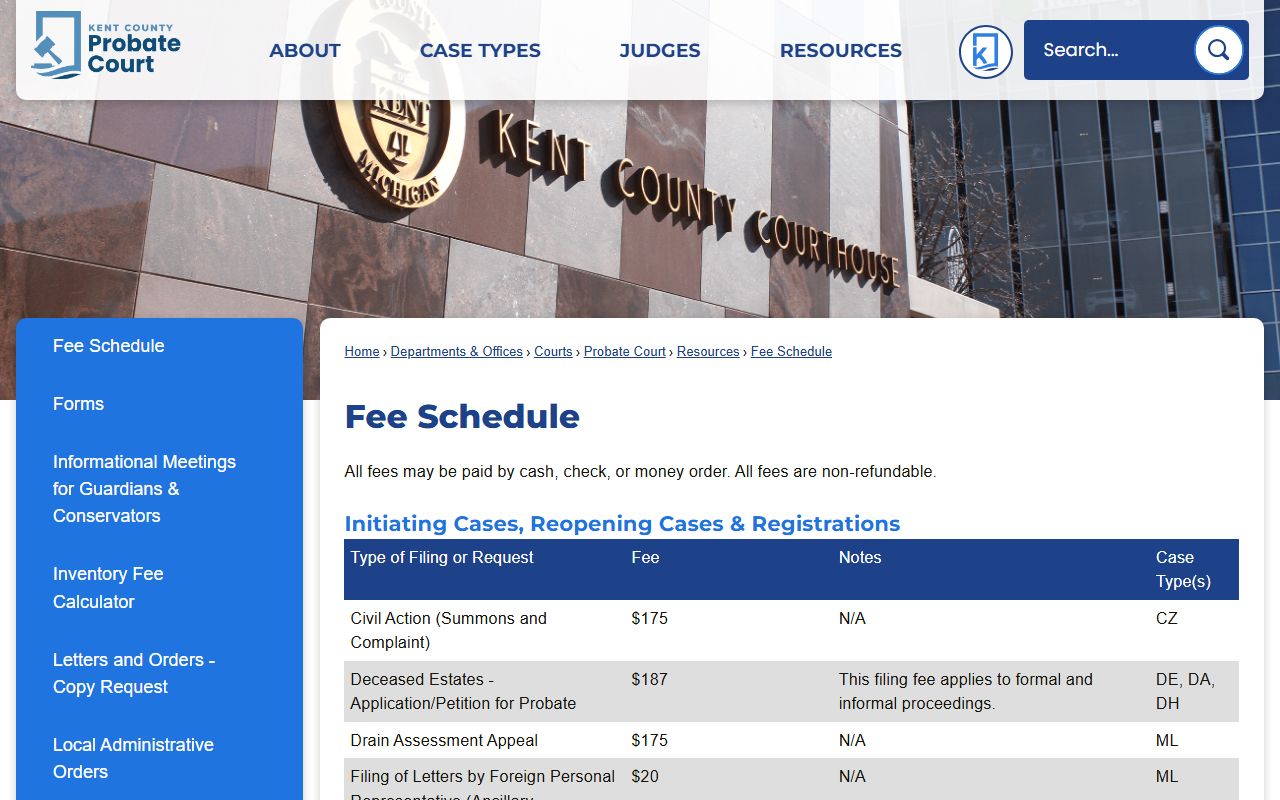
| Probate item | Fee / rule |
|---|---|
| Deceased Estate, Application or Petition for Probate | $187 for formal and informal proceedings |
| Inventory fee | Set by MCL 600.871(1); based on estate value, see bands below |
| Inventory fee rounding | Rounded to the nearest whole dollar since December 27, 2005 |
| Front counter address | 180 Ottawa Avenue NW, Suite 2500, Grand Rapids, MI 49503 |
| Phone for fee questions | 616-632-5440 |
A clerk cannot waive a fee without a court order. Fee waivers are based on income and are filed on a SCAO form at the time of the petition. The court reviews each waiver request before any fee is set aside.
Note: The $187 estate fee is separate from the inventory fee; both are due in most decedent estate cases filed in Kent County Probate Court.
Inventory Fee Calculator and Bands
The inventory fee is set by MCL 600.871(1) and runs on a sliding scale tied to the value of the estate. The state law sets the bands. The Kent County Probate Court provides an official online inventory fee calculator to plug in a value and read the fee. Cents are rounded to the nearest whole dollar: 1 to 49 cents rounds down, 50 to 99 cents rounds up. That rule has been in effect since December 27, 2005.
The image below shows the Kent County inventory fee calculator page, the same tool used by personal representatives across the county.
Source: Kent County inventory fee calculator.
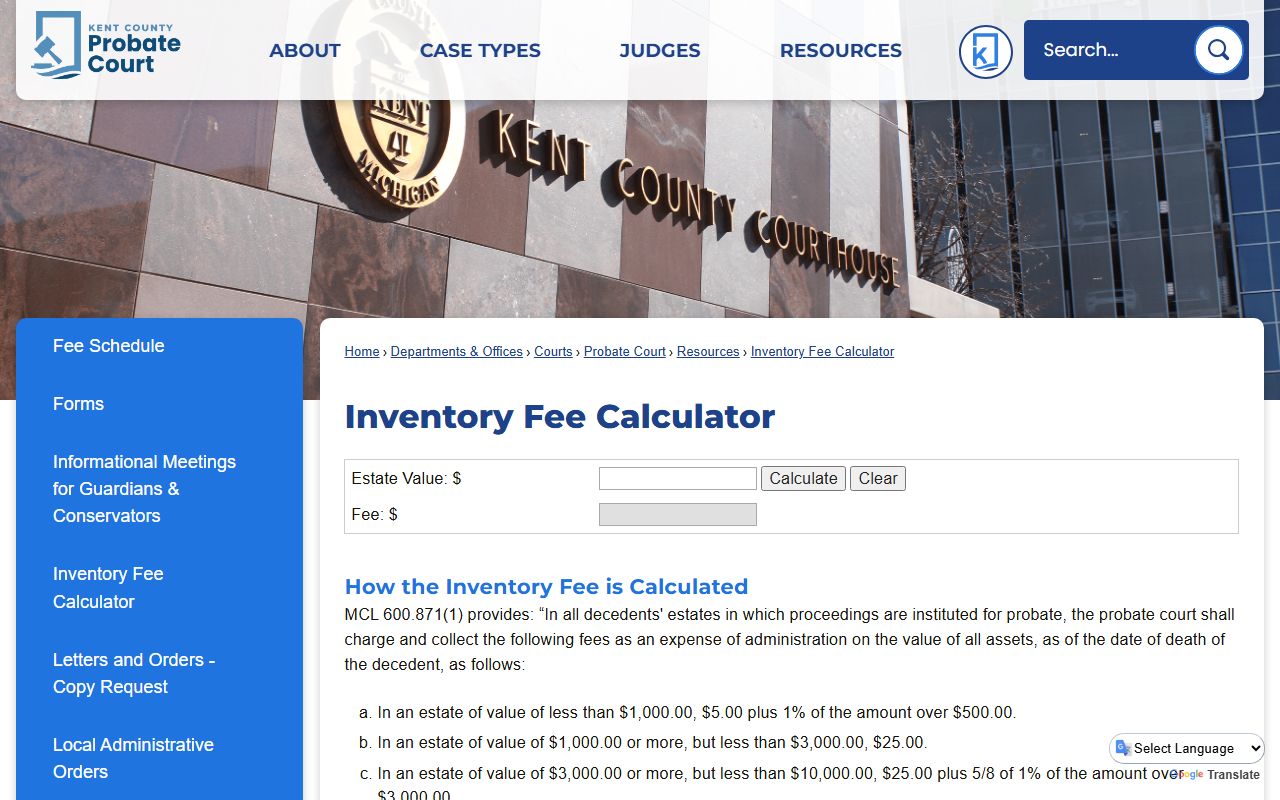
| Estate value | Inventory fee |
|---|---|
| Less than $1,000 | $5 plus 1% of the amount over $500 |
| $1,000 or more but less than $3,000 | $25 |
| $3,000 or more but less than $10,000 | $25 plus 5/8 of 1% over $3,000 |
| $10,000 or more but less than $25,000 | $68.75 plus 1/2 of 1% over $10,000 |
| $25,000 or more but less than $50,000 | $143.75 plus 3/8 of 1% over $25,000 |
| $50,000 or more but less than $100,000 | $237.50 plus 1/4 of 1% over $50,000 |
| $100,000 or more but less than $500,000 | $362.50 plus 1/8 of 1% over $100,000 |
| Over $500,000 | $62.50 for each additional $100,000 or larger fraction |
| Over $1,000,000 | $31.25 for each additional $100,000 or larger fraction |
The inventory fee is paid by the personal representative from estate funds. It is due when the inventory is filed. Plug a rough estate value into the online calculator before you walk into the counter so the cost is no surprise.
Minor Guardianships in Kent County
Minor guardianship is one of the most common reasons a Kent County family ends up at the Probate Court. A guardian for a minor is needed when a parent cannot care for a child, when a parent has died, or when other family steps in to take legal charge. The Probate Court has a dedicated minor guardianship page with forms and a list of common questions.
The image below shows the Kent County minor guardianships page, which points families to the right forms and the courthouse help office.
Source: Kent County minor guardianships.
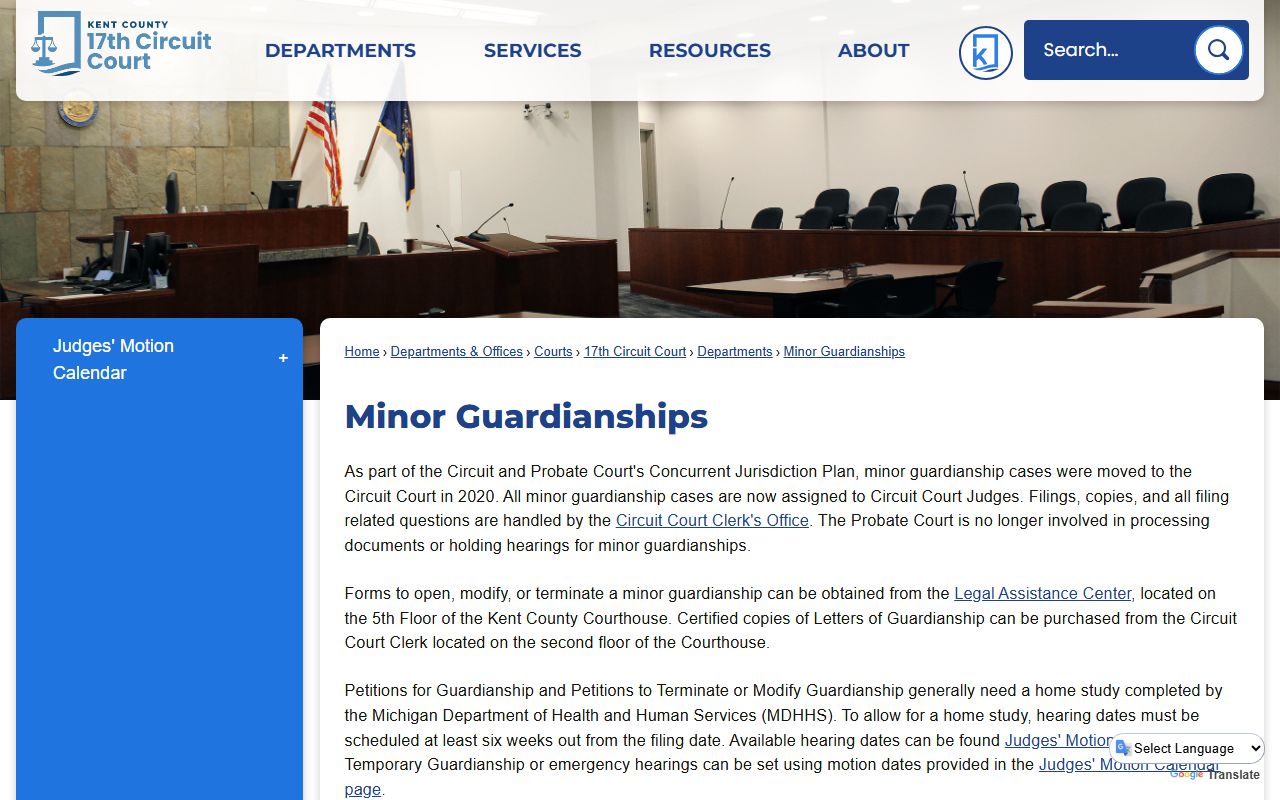
Forms to open, modify, or terminate a minor guardianship can be picked up from the Legal Assistance Center on the 5th floor of the courthouse. The same page covers practical issues, such as how a guardian gets court approval to travel out of state with a minor. The Probate Court page is a better starting point than a generic state form site because it ties forms to the local help office where staff can answer basic questions.
Probate Terms Glossary
Probate uses a set of legal terms that can be hard to track at first read. The list below covers the words a Kent County user is most likely to see on a probate form or in a court order.
- Testator
- The person who made a will. The estate is opened in the testator's name after death.
- Intestate
- Dying without a valid will. State law sets who inherits in an intestate estate.
- Personal representative
- The person the court appoints to manage a decedent's estate. Michigan uses this term instead of executor or administrator.
- Executor
- An older common name for a personal representative named in a will. The Michigan title is personal representative.
- Fiduciary
- Any person the court trusts to act for a protected person or an estate. Personal representatives, guardians, and conservators are all fiduciaries.
- Guardianship
- A court order giving one adult the power to make personal care choices for a minor or for an adult who cannot make safe choices.
- Conservatorship
- A court order giving one adult the power to manage the money and property of a protected person.
- Letters of authority
- The court paper that proves a personal representative, guardian, or conservator can act for the estate or the protected person.
- Inventory
- The list of estate property filed with the court. The inventory fee is based on the total value shown on this list.
Restricted Kent County Probate Records
Not every probate file is open to the public. Mental-health petitions and orders fall under tight court rules and state law. Protected-person files, which cover adults who cannot make safe choices, are also limited. The court does not post these files on the public web, and the counter will ask for proof of standing before it shares a copy.
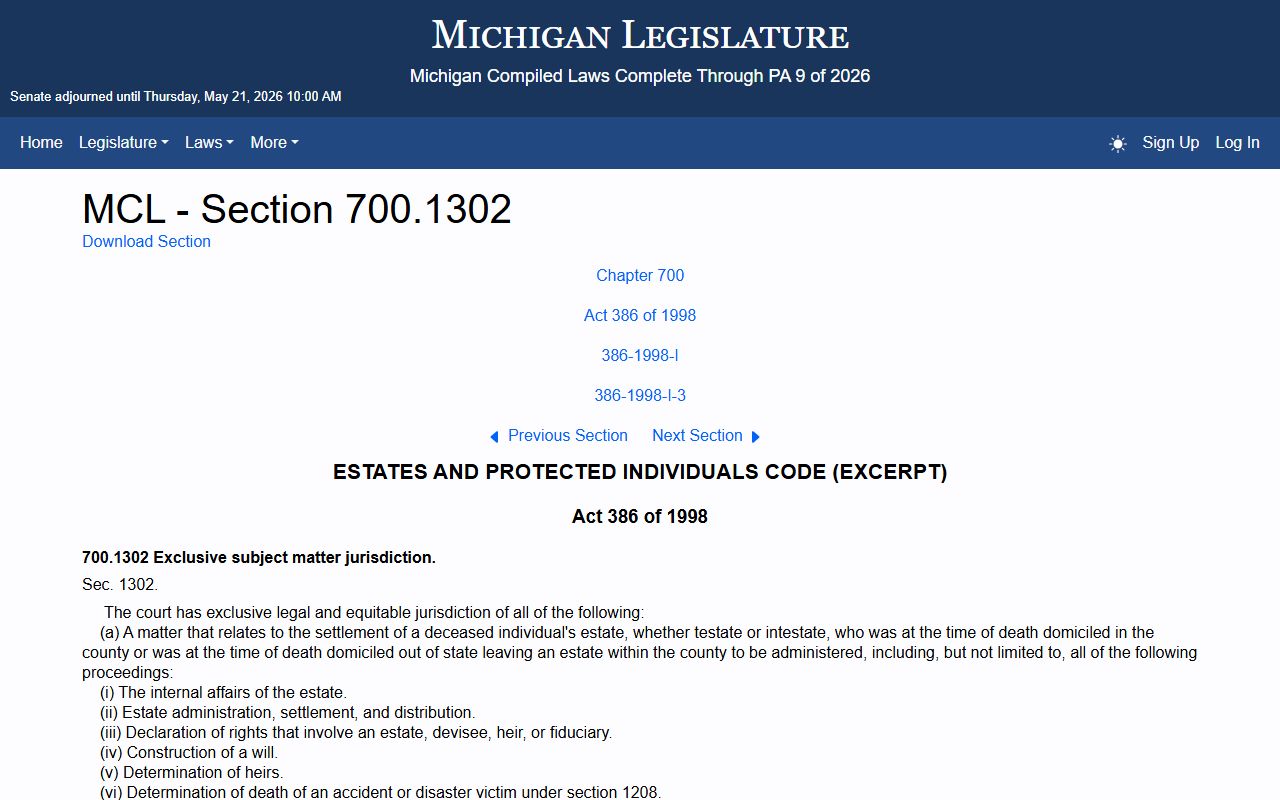
The image below shows the Michigan Probate Code section that sets the jurisdiction of the Probate Court, which is the root of the access rules for many of these files.
Source: MCL 700.1302, Probate Court jurisdiction.
Decedent estate files are more open in most cases. A will that has been admitted to probate is part of the public record. So is a basic guardianship order. Medical reports, mental-health evaluations, and financial account numbers inside a file are blocked from the public view by court rule. To view a sealed item, a party usually files a motion in the Probate Court. The judge weighs the public interest against the privacy of the people in the file.
Note: Mental-health and protected-person probate records in Kent County are restricted; the Probate Court will not release them without proof of standing or a court order.