
Michigan FOIA and Kent County
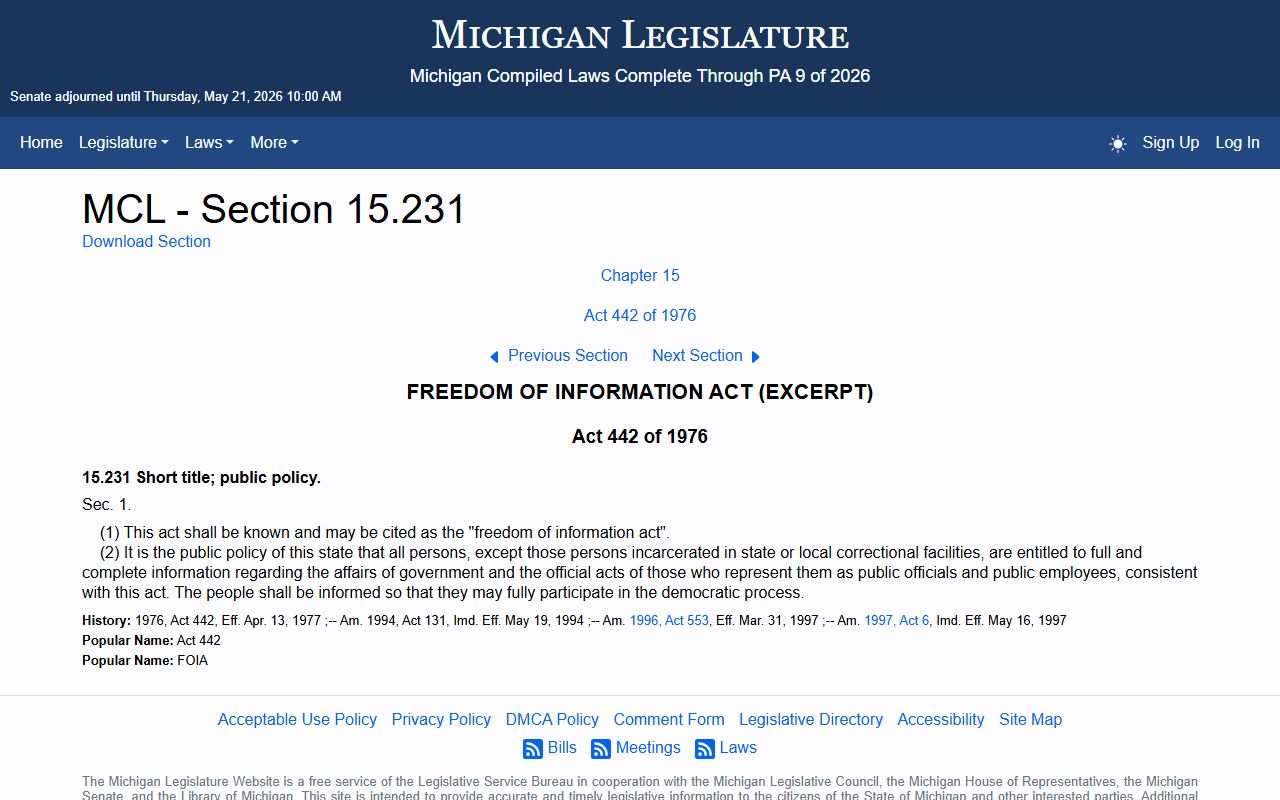
The Michigan Freedom of Information Act sets the base rule for public records in Kent County. The act starts at MCL 15.231 with a clear policy. The people are entitled to full and complete information about the acts of those who hold public office. The county, the sheriff, the road commission, the parks, the prosecutor's administrative files, and every other public body in Kent County fall under that policy. A request is filed with the public body that holds the record, not with one central office.
The image below shows the Michigan FOIA policy section, which is the legal hook for any Kent County FOIA request.
Source: MCL 15.231, Michigan FOIA policy.
Kent County runs its own FOIA intake page at accesskent.com/Departments/FOIA. The page lists the FOIA coordinator, the request form, and the fee policy. A request can be sent by mail, email, or in person. The county must answer in writing inside the deadline set by the act. The answer can grant the request in full, grant in part, deny in full, or ask for more time. A denial must cite a reason that the act allows.
Court Records Are Not FOIA Records
This is the most common point of confusion. A court case file is not a FOIA record. Michigan court files run under Michigan Court Rule 8.119, not the FOIA. The rule sets the case index, the record types, the access rules, and the limits on what the clerk can release. A request for a case file goes to the clerk of the court that holds the case, not to the county FOIA coordinator.
Use FOIA for things like a sheriff use-of-force policy, a budget, a contract, a personnel rule, or a road project file. Use the clerk for a divorce judgment, a felony docket, a probate order, or a traffic case. The two paths use different forms, different fees, and different timelines. A clerk cannot fill a FOIA request for a court file. A FOIA coordinator cannot pull a sealed adoption order. The split matters because it decides where the request goes and how long the wait will be.
For a court file, see the Kent County court records page and the Clerk of the Court page. For a sheriff record, the path depends on the type. A booking record is on the public Web Jail Viewer. A use-of-force report or a sheriff policy goes through FOIA.
How to File a Kent County FOIA Request
The county FOIA process is the same in spirit across departments. Each public body has its own coordinator, but the steps for a Kent County FOIA request follow one shape. Have the record description ready before you start. Write down the date range, the type of record, and the office that likely holds it. A clear request gets a faster answer and a smaller fee.
- Pick the public body. Kent County, the Sheriff's Office, the Road Commission, the Prosecutor's office, the Drain Commission, and city or township agencies are all separate public bodies. Start with the office that holds the file.
- Open the Kent County FOIA page at accesskent.com/Departments/FOIA. The page lists the FOIA coordinator, the request form, the mailing address, and the fee deposit rules.
- Describe the record. Use plain words. Give a date range. Name the department if you can. A broad request takes longer and costs more in labor.
- State the format. Ask for email, PDF, paper copies, or in-person inspection. Inspection is the cheapest path under MCL 15.233.
- Sign and send. Send by mail, email, or in person. A fax also counts under the act. Keep a copy of the request and the date you sent it.
- Watch the deadline. The public body has five business days to respond. The body can take one ten-business-day extension by written notice. A failure to respond is treated as a final denial.
- Review the response. The body may grant, grant in part, deny, or ask for a deposit. If a deposit is asked for and the fee is high, send the deposit to keep the request moving.
- Appeal a denial. A written appeal goes to the head of the public body. The head has ten business days to act. The act also allows a suit in circuit court.
Indigent requesters and certain nonprofit public bodies can ask for a fee waiver. The act allows a discount for the first part of the labor fee in some cases. The county page lists the current waiver rule.
FOIA Fees Under MCL 15.234
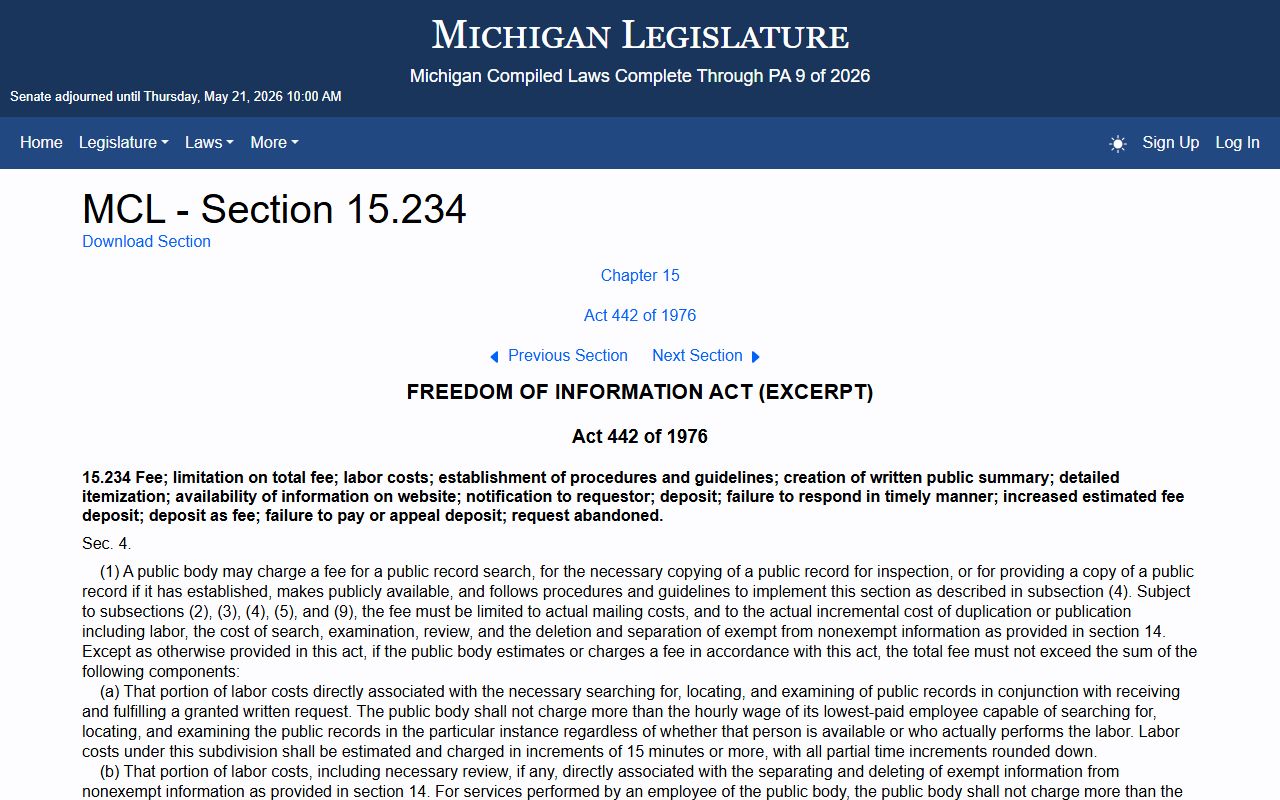
Fees on a Kent County FOIA request are set by MCL 15.234. The statute does not name one flat dollar amount. It lists the cost types a public body can charge and the limits on each type. The body must use a written fee policy. It must itemize the charge on the response. The cost cannot top the actual cost to the body.
The image below shows the Michigan FOIA fee statute, which controls what Kent County can charge for a public records request.
Source: MCL 15.234, FOIA fees.
| Cost Type | What It Covers | Statute Note |
|---|---|---|
| Labor for search | Time staff spend to find the records. | Capped at the hourly wage of the lowest-paid qualified employee. |
| Labor for review and redaction | Time to review the file and black out exempt data. | Same wage cap; only allowed when redaction is needed. |
| Labor for copying | Time spent at the copier or the scanner. | Same wage cap. |
| Copy cost per page | Paper, ink, and per-page rate. | Per-page rate cannot top 10 cents for letter or legal size unless actual cost is higher and is shown. |
| Nonpaper media | USB drives, discs, or other media. | Limited to actual cost of the media. |
| Mailing | Postage and the envelope. | Actual cost only. No markup. |
| Indigent waiver | First $20 of the fee waived for a qualifying person. | Affidavit of indigence required. |
Court fees are not on this table. A court fee for a case copy is set by the clerk and by court rule. The clerk does not use FOIA wages. The county FOIA office cannot quote a court fee. Check the Clerk of the Court page or the relevant court counter for the copy schedule.
Kent County FOIA Request Form Fields
A Kent County FOIA request can be sent on the county form or as a plain written letter. Either way, the body needs a fixed set of facts to act. Missing one of the core fields will slow the response. The chart below tracks the fields the county form asks for and what the act requires.
| Field Label | Type | Required | Notes / Format |
|---|---|---|---|
| Requester name | Text | Yes | Full legal name of the person filing. |
| Mailing address | Text | Yes | Used for the written response and any paper copies. |
| Email address | Text | Optional | Speeds the answer. Best for digital delivery. |
| Phone number | Text | Optional | Used if the coordinator needs to clarify the request. |
| Description of records | Long text | Yes | Plain words. Include date range and department. |
| Date range | Date / date | Recommended | Cuts labor cost. Narrow ranges return faster. |
| Preferred format | Checkbox | Yes | Paper, PDF, email, or in-person inspection. |
| Fee waiver request | Checkbox | Optional | Indigent or public-interest waiver. Affidavit required for indigent. |
| Signature and date | Signature | Yes | Wet or e-signature. Mail, email, fax, or in person. |
The county can ask for a written deposit if the estimated fee tops the threshold in the act. The deposit cannot top half of the estimated fee under MCL 15.234. Keep proof of the deposit. The receipt sets the date the work must start.
Response Timelines and Denials
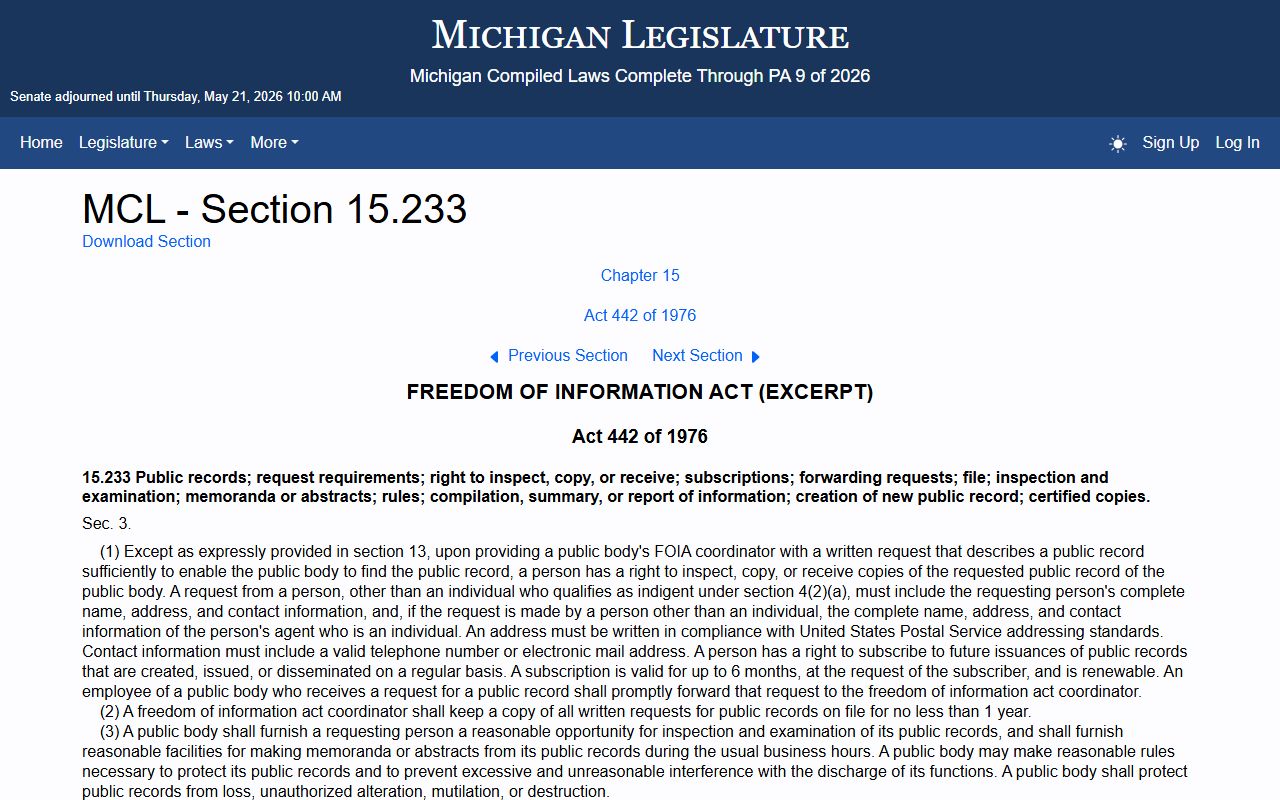
The clock starts the day the public body gets the request. Kent County has five business days to give a written answer. The body can take one written extension of ten business days. After the extension, no more time is allowed. A failure to respond counts as a final denial under the act and opens a path to appeal or to circuit court.
The image below shows the Michigan FOIA right to inspect and copy, which is the source of the response duty.
Source: MCL 15.233, FOIA right to inspect and copy.
A denial must cite an exemption in the act or in another statute. Common reasons in Kent County include personal privacy, attorney work product, ongoing investigation, security plans, and items sealed by court order. The denial must also tell the requester how to appeal. A written appeal goes to the head of the public body. The head has ten business days to keep, reverse, or change the denial. If the denial is kept, the next step is a suit in circuit court. A win at trial can get attorney fees and a punitive fine under the act.
Note: A short, plain request gets a faster answer than a long catch-all. List the date range and the office to keep the labor fee low.
Kent County Clerk and Register Records
The Kent County Clerk and Register of Deeds keeps a wide set of public records that do not go through FOIA at all. Many of these records have their own access path and their own copy fee. The office covers vital records like marriage, recorded land records like deeds and mortgages, business filings like assumed names, elections, campaign filings, and notary records. The Clerk's office sits in the County Administration Building at 300 Monroe Avenue NW, Grand Rapids, MI 49503, open Monday through Friday from 8 am to 4:45 pm.
County Clerk / Register of Deeds
300 Monroe Avenue NW
Grand Rapids, MI 49503
616-632-7640
Mon-Fri 8 am - 4:45 pm
Clerk of the Court
180 Ottawa Avenue NW, Suite 2400
Grand Rapids, MI 49503
616-632-5480
Mon-Fri 9 am - 4 pm
Online search for many recorded county records runs through the AccessKent system at accesskent.com/CNSearch. Some functions need a login. The public counter remains open for users who want a paper copy or a certified seal. A certified copy of a marriage record or a deed is the standard format for legal proof. Plain web prints are not the same as a certified copy.
For a divorce decree, the case file lives with the 17th Circuit Court clerk, but the County Clerk holds the matching vital record. For a marriage license, the County Clerk is the only office that can take the application. The split is a holdover from the long-standing Michigan rule that the County Clerk acts as keeper of both the court record of judgment and the vital record of marriage.
Sheriff Administrative Records
The Kent County Sheriff's Office is a public body under FOIA for its administrative files. Patrol policies, training records, complaint procedures, internal use-of-force data, contracts, and budget files are FOIA records. A request goes to the Sheriff's Office FOIA coordinator, not to county central FOIA. The Sheriff page lists the address and the contact info for the request.
Some sheriff records are not FOIA at all. The jail booking roster runs as a public live tool on the Web Jail Viewer. Anyone can search by last name without a request. Active warrants are managed under court order and have their own access rule. A criminal incident report from a closed case can be released under FOIA, but a report from an open case may be held back to protect the case. The sheriff cites the open-investigation exemption when that applies.
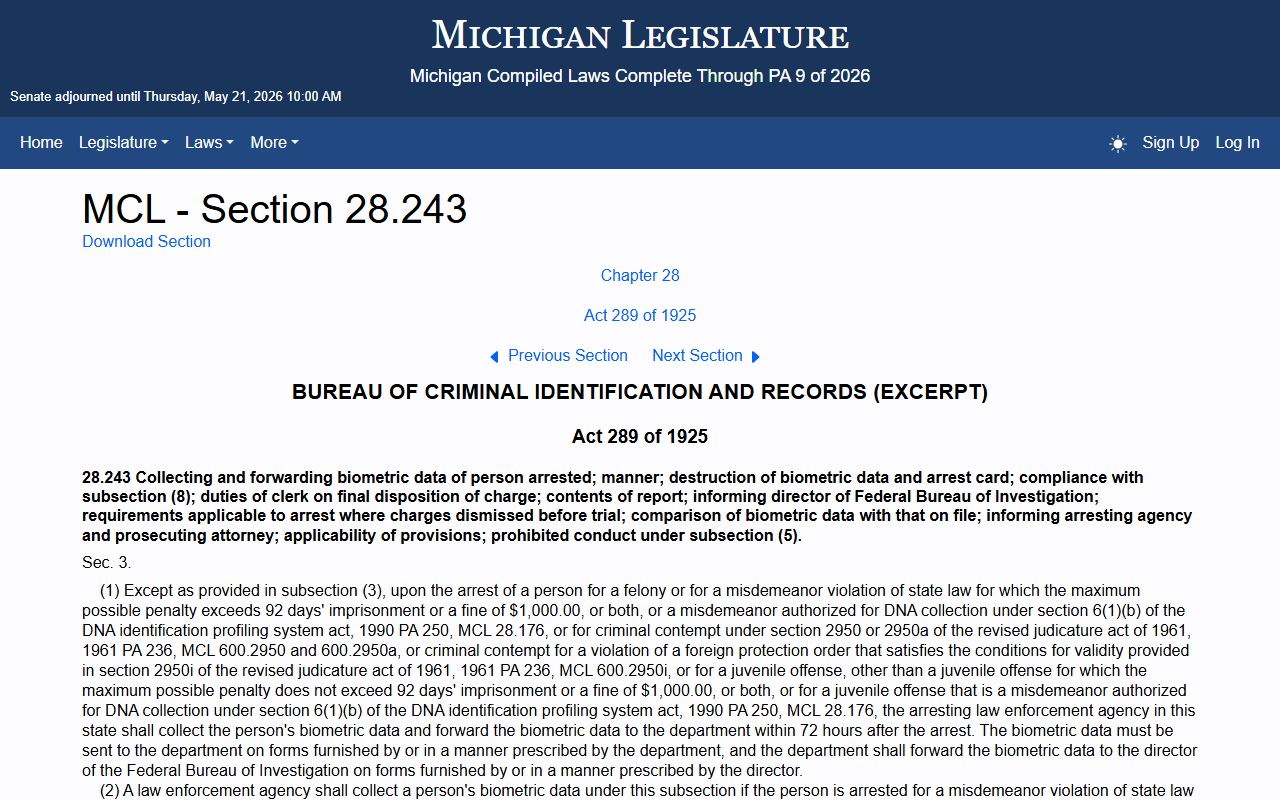
The Michigan State Police runs ICHAT for paid criminal history searches. ICHAT is governed by MCL 28.243. The image below shows the criminal history dissemination statute that sets the rules for that path.
Source: MCL 28.243, criminal history dissemination.
For arrest and booking lookups, see the arrest records page. For active warrants, see the warrant records page. For inmate custody, see the inmate records page.
Michigan Vital Records Limits
Vital records in Michigan are not full FOIA records. They have their own access law at MCL 333.5129. The statute limits who can get a certified copy of a birth or death record and how. A birth record is restricted for 100 years from the date of birth. Only the named person, a parent named on the record, a legal guardian, an heir, or a court-ordered party may pull a certified copy in that window. A death record is open after a shorter wait.
Marriage and divorce records held by Kent County follow a separate rule. A marriage record is a Clerk record from the day the license is filed. A divorce record sits in the circuit court file plus in the County Clerk's vital books. For a certified marriage record, the request goes to the Kent County Clerk. For a certified state-level copy of a Michigan vital record, the request can also go to the Michigan Vital Records office in Lansing.
| Record Type | Where to Request in Kent County | Access Rule |
|---|---|---|
| Birth record | County Clerk or state Vital Records | Restricted for 100 years under MCL 333.5129. |
| Death record | County Clerk or state Vital Records | Open to the public for most records. |
| Marriage record | County Clerk, 300 Monroe Avenue NW | Public on file with the County Clerk. |
| Divorce record | 17th Circuit Court for case file; County Clerk for vital record | Case file open under MCR 8.119; some parts may be sealed. |
For a deeper read on marriage and divorce files, see the marriage and divorce records page.
Records That Cannot Be Released
Some Kent County records stay closed by law. A FOIA request will not unlock them. A court order is the only path for many of these files, and even a court order will not open every one. The rule on each type is set by a different statute. The county FOIA coordinator must cite the right exemption when denying a request.
- Juvenile delinquency and child protective files: closed under MCL 712A.28. Only parties, attorneys, agencies, and court-approved users can view.
- Adoption records: closed under MCL 710.67. The court must approve any release.
- Set-aside criminal records: removed from public view under MCL 780.621 after the court grants the set-aside. Courts and police may still see them.
- Mental-health and treatment records: closed under Michigan mental-health law. The probate file may have public parts and closed parts.
- Grand jury and active investigation files: not released while the case is open. A FOIA denial cites the investigation exemption.
- Personal identifiers: social security numbers, financial account numbers, minor names, and home addresses for protected parties are redacted before release.
- Attorney work product: privileged material does not lose its status because a county office has a copy.
The Clean Slate law in Michigan added automatic set-aside for many older convictions. A set-aside is not the same as a destroyed record. The data still sits in court files. Public access is what changes. For more on what shows on a docket and what does not, see the court records page and the arrest records page.